
From a financial, tax, and operational perspective, buying individual residential properties generates excessive tax exposure and management drag. The US market offers far superior asset classes and institutional deal structures that deliver consistent cash flow without requiring active operational involvement.
1. Navigating Non-Resident Tax Regulations
Foreign investors entering the US market encounter distinct legal and tax frameworks. Failing to structure these transactions correctly can result in a 40% loss of equity upon transfer or significant capital lockups during a sale.
Key Foreign Investor Tax Risks
-
US Estate Tax: While US citizens enjoy multi-million-dollar estate tax exemptions, non-resident aliens (NRAs) are subject to an exemption threshold of just $60,000. Directly held assets exceeding this amount are taxed at rates up to 40%.
-
FIRPTA (Foreign Investment in Real Property Tax Act): Under FIRPTA, buyers purchasing US real estate from a foreign seller must withhold 15% of the gross purchase price (not the net profit). The IRS holds these funds until the seller files a final tax return to calculate actual capital gains.
-
Tax Filing Obligations (Form 1040-NR): Any US rental income requires a non-resident individual tax return (Form 1040-NR) and an Individual Taxpayer Identification Number (ITIN).
Directly owning residential rental property creates recurring overhead, tenant management friction, and full exposure to federal estate taxes unless wrapped in an optimal legal structure.
2. Asset Class Comparative Analysis
Passive cross-border capital performs best in commercial asset classes with distributed operational risk and inflation-indexed lease structures.
Multifamily (Class B/C Apartment Communities)
Acquiring 50 to 300+ unit residential communities via real estate syndications or private equity funds, where the investor participates as a Limited Partner (LP).
-
Advantages: High occupancy stability derived from a diversified tenant base. The General Partner (GP) handles all property management. Investors gain access to accelerated depreciation (Cost Segregation), reducing taxable income on distributions to near zero.
-
Target Returns: Average Cash-on-Cash returns range from 6% to 8%, with total projected Internal Rates of Return (IRR) of 12% to 15% over a 5-year hold.
Industrial & Logistics
Last-mile distribution hubs, warehousing, and light industrial facilities.
-
Advantages: Minimal tenant improvement costs and long-term lease structures (5 to 10 years) with built-in annual rent escalations (typically 2% to 4%). E-commerce growth provides strong downside protection across market cycles.
-
Target Returns: Going-in Cap Rates generally range from 5.5% to 7.0%.
NNN Commercial Leases (Triple Net)
Single-tenant commercial assets backed by corporate-grade credit tenants (e.g., Walgreens, CVS, Dollar General, or national drive-thru franchises).
-
Advantages: Under a Triple Net lease, the tenant is contractually responsible for property taxes, building insurance, and all maintenance/capital repairs. The landlord receives pure passive income.
-
Target Returns: Cap Rates range between 5.5% and 6.5% with low operational risk.
Single-Family Homes and Condominiums
-
Disadvantages: High property management fees (8% to 10% of gross rent), single-tenant vacancy risks, and unrecoverable turnover costs between leases.
-
Target Returns: Net Cap Rates rarely exceed 3.0% to 4.5% once management fees, property taxes, HOA dues, and maintenance reserves are deducted.
Asset Class Comparison Matrix
|
Parameter |
Multifamily (LP) |
Industrial / Logistics |
NNN Commercial |
Single-Family / Condo |
|---|---|---|---|---|
|
Average Cap Rate |
5.5% – 7.0% |
5.5% – 7.0% |
5.5% – 6.5% |
3.0% – 4.5% |
|
Management Drag |
100% Passive |
Low / Moderate |
100% Passive |
High / Active Control |
|
Tax Efficiency |
Maximum (Cost Segregation) |
High |
Moderate |
Low |
|
Vacancy Risk |
Low (Diversified Units) |
Low (Long-term Leases) |
Minimal (Credit Tenant) |
High (100% On Vacancy) |
|
Capex Exposure |
Paid via Fund Reserves |
Minimal |
100% Tenant Obligation |
100% Landlord Obligation |
3. Geographic Allocation: Sunbelt vs. Gateway Markets
Selecting the right state is just as critical as choosing the right asset class. Tax environments and landlord regulations vary significantly across jurisdictions. 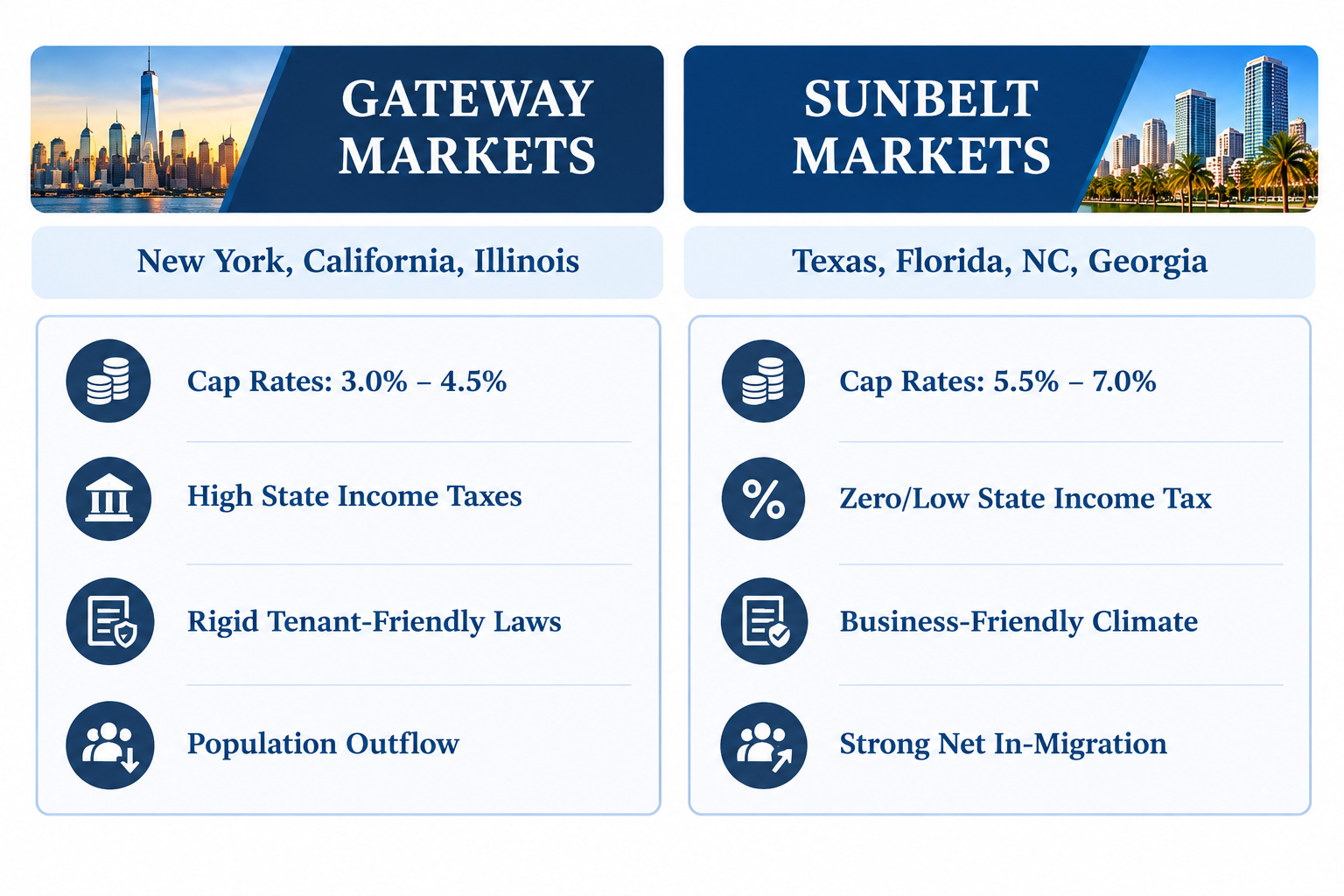
-
Gateway Cities (New York, Los Angeles, San Francisco, Chicago): Compressed Cap Rates, high local income tax burdens, and strict tenant-protection laws. Eviction proceedings in these jurisdictions can take months or years, stalling property cash flow.
-
Sunbelt States (Texas, Florida, North Carolina, Georgia, Tennessee): Beneficiaries of business expansion and net in-migration due to favorable economic climates. States with no income tax (such as Texas and Florida) and landlord-friendly legal frameworks yield superior risk-adjusted returns and lower tenant turnover.
4. Entity Structuring and Tax Optimization
Purchasing US real estate in a personal name creates unnecessary financial risk. A two-tiered corporate ownership structure insulates investors from liability while eliminating exposure to the US estate tax. 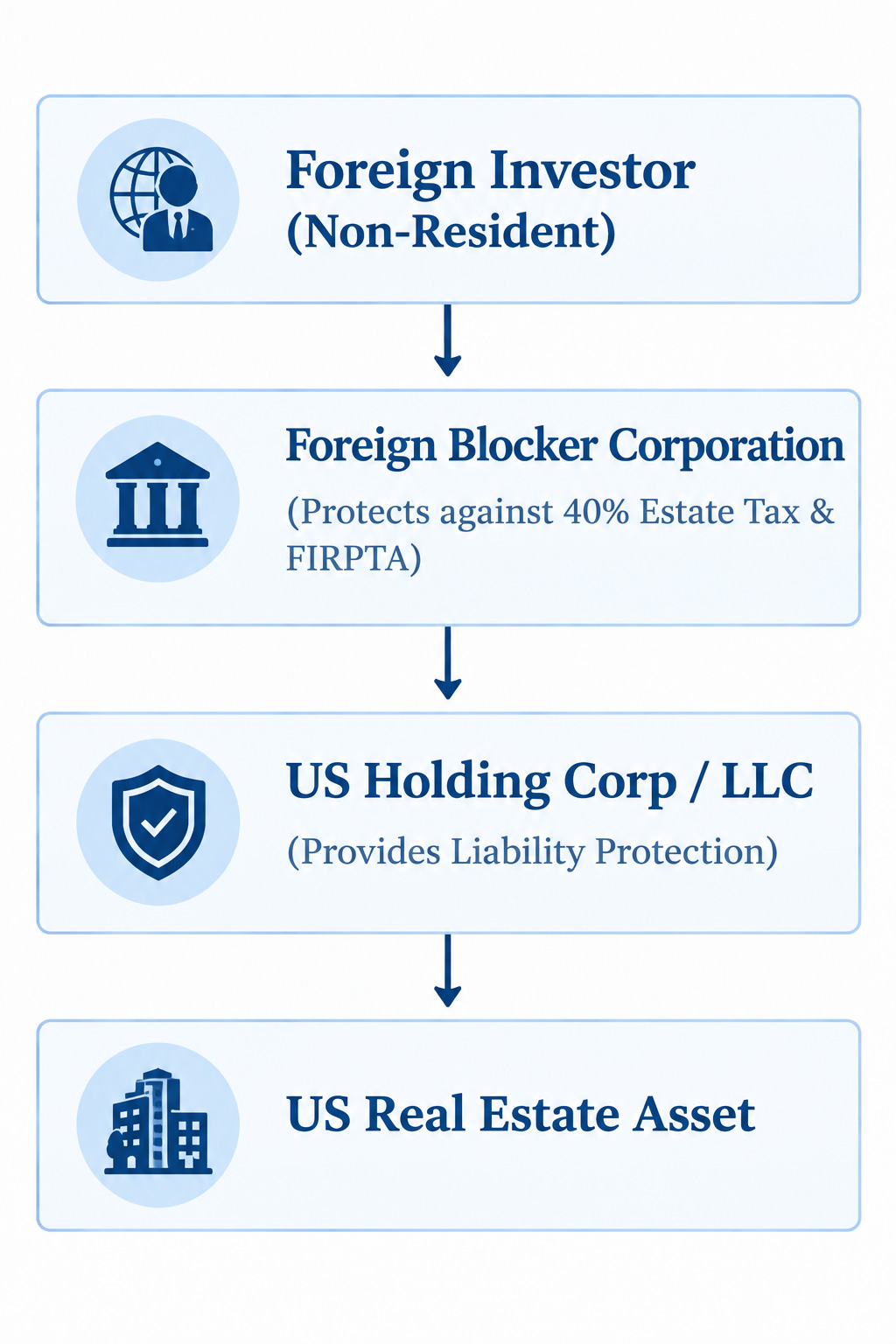
Optimal Corporate Structure
-
US LLC (Limited Liability Company): Established in the asset's home state or a privacy-focused jurisdiction (e.g., Wyoming or Delaware). Shields personal assets from operational liabilities.
-
Foreign Blocker Corporation: Positioned directly above the US entity. Because a foreign corporation owns the US asset, the death of the individual foreign shareholder does not trigger a transfer of US-situs property, completely insulating the estate from the 40% US Estate Tax.
Cost Segregation and Accelerated Depreciation
Under US tax law, residential real property is depreciated over 27.5 years, while commercial property is depreciated over 39 years.
By executing a Cost Segregation Study, an investor can reclassify specific building components (lighting, flooring, site improvements) to shorter 5-, 7-, or 15-year recovery periods. This creates substantial paper losses that offset rental income, bringing current US tax liability down to zero or minimal levels.
5. Non-Resident Investor Checklist
To enter the US real estate market safely, complete the following steps prior to closing:
-
Obtain Tax Identification Numbers: Apply for an Employer Identification Number (EIN) for the entity and an Individual Taxpayer Identification Number (ITIN) for the investor.
-
Establish the Entity Structure: Set up the US LLC and Foreign Blocker Corporation through specialized legal counsel.
-
Open US Corporate Bank Accounts: Complete corporate Know Your Customer (KYC) onboarding with a US banking institution.
-
Engage a Non-Resident CPA: Partner with a Certified Public Accountant specializing in international tax planning, FIRPTA compliance, and cross-border treaties.
-
Secure Insurance Coverage: Obtain comprehensive property and casualty insurance alongside a $1M to $5M Umbrella Liability Policy.
Summary
Successful cross-border real estate investment in the US relies on avoiding domestic retail strategies. Institutional asset classes—such as Multifamily, Industrial, and NNN Leases in Sunbelt markets—provide optimal risk-adjusted returns and passive cash flows.
Tax structuring and entity design must precede property selection when investing in the US market from abroad.
This material is for general information only and does not constitute legal, immigration, investment, or tax advice. Program requirements and processing practices may change. Individual results depend on the applicant’s circumstances, visa availability, USCIS decisions, and project performance.