Visa Quota Limits and the 2027 Regulatory Bottleneck
Current legislation fixes the minimum investment threshold at $800,000 for Targeted Employment Area (TEA) projects and $1,050,000 for standard infrastructure or non-TEA locations. The RIA framework established dedicated reserved visa pools (Visas Set-Asides):
- 20% of the total annual allocation (~2,000 visas) reserved for rural projects (Rural TEA);
- 10% (~1,000 visas) reserved for high-unemployment projects (High Unemployment TEA);
- 2% (~200 visas) reserved for infrastructure projects.
By 2027, the carryover visa reserves in set-aside categories from prior fiscal years will be fully exhausted. High-demand countries (such as China and India) will face formal retrogression queues, even within the rural category. Conversely, for applicants from the CIS, MENA, and Latin American regions, unreserved visa windows will remain accessible, provided their I-526E petitions are filed prior to statutory legislative review.
Concurrently, an automatic inflation-driven adjustment of investment thresholds takes effect in 2027. Under RIA provisions, minimum capital requirements undergo mandatory recalculation every five years linked to the Consumer Price Index (CPI). Projected U.S. cumulative inflation between 2022 and 2027 will elevate the baseline TEA investment threshold from $800,000 to an estimated $920,000–$950,000.
The statutory Grandfathering Clause guarantees that USCIS must continue processing all I-526E petitions filed on or before September 30, 2027 under the regulations and capital thresholds active at the time of submission, protecting investors even in the event of a temporary Congressional reauthorization delay.
Financial Metrics and Liquidity: Capital Return Structures
The EB-5 investment model operates as a capital preservation mechanism offering a fixed baseline return, prioritizing the return of principal over aggressive equity yields.
The weighted average preferred return paid by Regional Centers to EB-5 investors under standard debt structures (Mezzanine Debt) averages 0.25% to 1.50% per annum. Project developers utilize EB-5 capital to replace expensive senior or commercial debt, where prevailing U.S. interest rates remain at 7.50% to 9.50%.
Financial Parameters of Standard EB-5 Structures
|
Parameter |
Debt Model (Loan Model) |
Equity Model |
|---|---|---|
|
Minimum Capital Investment |
$800,000 (TEA) / $1,050,000 |
$800,000 (TEA) / $1,050,000 |
|
Administrative Fee |
$70,000 – $90,000 (one-time) |
$70,000 – $90,000 (one-time) |
|
Preferred Investor Yield |
0.25% – 1.0% p.a. |
1.0% – 3.0% (variable / non-guaranteed) |
|
Capital Repayment Term |
5 – 7 years |
5 – 8+ years |
|
Collateral Position |
2nd position real estate lien / Equity Pledge |
Membership interest in LLC |
The RIA rule shortening the capital sustainment period to two years from the full creation of 10 required jobs alters liquidity timelines. For petitions filed post-March 2022, the two-year repayment clock ties directly to job creation compliance rather than the adjudication of the conditional Green Card removal petition (Form I-829). By 2027, the initial wave of principal repayments under the updated RIA sustainment rules will commence.
Concurrent Filing Mechanics and Compliance Standards
For investors residing lawfully within the United States under non-immigrant classifications (H-1B, L-1, F-1, or E-2),Concurrent Filing remains a primary advantage of the current law.
This procedural avenue allows simultaneous submission of:
- Immigrant Petition by Regional Center Investor (Form I-526E);
- Application to Register Permanent Residence or Adjust Status (Form I-485);
- Application for Employment Authorization (EAD / Form I-765);
- Application for Travel Document (Advance Parole / Form I-131).
Adjudication of the EAD and Advance Parole (Combo Card) averages 3 to 6 months. This grants the investor and family members immediate legal authorization to reside, work, and study in the U.S. while the underlying I-526E petition is processed.
EB-5 Procedural Roadmap & Timeline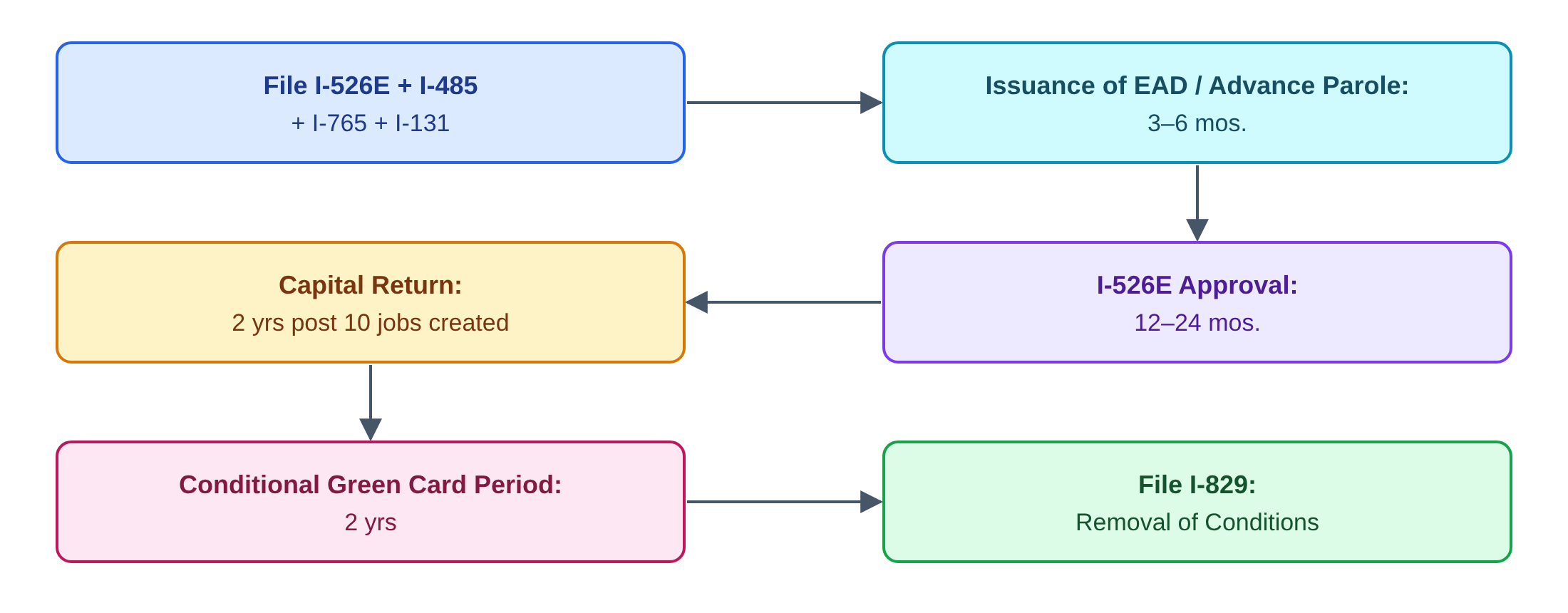
In parallel, anti-money laundering (AML) protocols regarding Source of Funds (SOF) have intensified. Petitions require full documentary tracing of tax returns, dividend distributions, real estate sales proceeds, or execute-deed gift structures.All capital transfers originating from overseas accounts undergo strict correspondent bank clearing in the U.S., supported by certified independent forensic audit filings (Source and Path of Funds Reports).
Regional Center Selection Metrics and Developer Risk Control
Capital preservation relies heavily on evaluating the project's Capital Stack. Reputable Regional Centers with proven institutional track records structure financing packages where EB-5 capital accounts for no more than 20% to 30% of total project costs. Senior commercial bank financing typically covers 50% to 60% of total development expenditure.
Institutional evaluation of EB-5 offerings entering 2027 centers on three structural safeguards:
- Job Creation Buffer: Project underwriting should forecast a job creation margin of 12 to 15 jobs per investor against the statutory requirement of 10 jobs. Calculations relying on eligible hard construction expenditures (utilizing RIMS II or IMPLAN economic input-output models) remove operational revenue risks upon construction completion.
- Completion Guarantee: An unconditional, irrevocable completion guarantee issued by the developer’s parent entity mitigates risks associated with budget overruns or construction halts.
- Escrow Release Conditions: Institutional escrow structures release EB-5 capital to the borrower only upon formal I-526E filing receipt, approval, or the deployment of qualified bridge financing.
Navigating the EB-5 landscape in 2027 requires investors to finalize filings prior to statutory sunset deadlines. Rising capital thresholds and shifting visa set-aside allocations make early compliance verification and selection of structurally sound projects the paramount factors for success.
This material is for general information only and does not constitute legal, immigration, investment, or tax advice. Program requirements and processing practices may change. Individual results depend on the applicant’s circumstances, visa availability, USCIS decisions, and project performance.