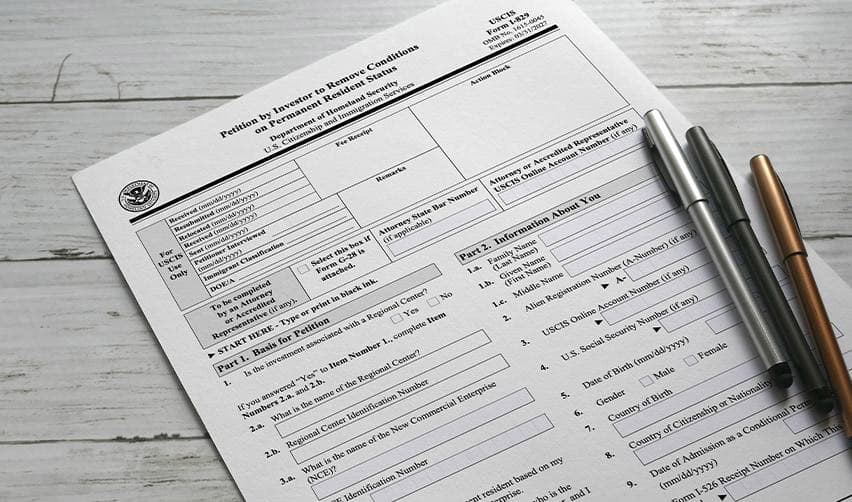
The Purpose and Legal Status of Form I-829
Form I-829 (Petition by Investor to Remove Conditions on Permanent Resident Status) is filed by an investor who previously obtained conditional permanent residence based on an approved Form I-526 or I-526E. Submitting this document marks the completion of the investment cycle and transitions the investor and their qualifying family members to unconditional permanent resident status.
The core legal function of Form I-829 is proving that the investor maintained their capital investment throughout the required conditional residence period and satisfied all job creation obligations.
US immigration law establishes a strict filing window: Form I-829 must be submitted to USCIS within the 90-day period immediately preceding the expiration date of the conditional Green Card. Filing before or after this window will lead to the rejection of the petition or termination of resident status.
Three Primary Approval Criteria
USCIS evaluates Form I-829 based on actual performance and evidence of compliance. Decisions depend on verifying three core parameters.
1. Sustaining Capital At-Risk
The applicant must prove that the required investment capital ($800,000 in a TEA or $1,050,000 in a non-TEA project) remained continuously invested in the New Commercial Enterprise (NCE) and subject to commercial risk throughout the two-year conditional residence period.
Required evidentiary documentation includes:
-
NCE bank statements demonstrating the movement and deployment of capital.
-
Audited financial statements and corporate tax returns.
-
Proof of capital allocation into the project (equipment purchases, construction funding, operational expenditures).
-
Absence of any redemption or guaranteed return agreements prior to I-829 approval.
2. Proof of Continuous Business Operations
The investor must present evidence that the NCE or Job Creating Entity (JCE) was established, actively operated, and maintained continuous commercial activity throughout the conditional residency period.
USCIS verifies corporate registration documents, organizational reports, commercial lease agreements, business contracts, and proof of local and federal tax payments.
3. Creation of 10 Full-Time Jobs
The key approval requirement for Form I-829 is confirming that the investment generated at least 10 full-time jobs for qualifying US workers per investor.
-
Direct Investments (Form I-526): Proof includes Forms W-2, Forms I-9 (verifying US work authorization), quarterly payroll tax reports (Form 941), and employee pay stubs.
-
Regional Center Investments (Form I-526E): Proof includes economic impact reports confirming construction spending and operational expenditures. Approved economic models (such as IMPLAN or RIMS II) calculate the creation of direct, indirect, and induced jobs.
Required Documentation Package
The Form I-829 petition package is prepared by the investor in coordination with immigration counsel, the Regional Center, or project management.
Personal Documents (Investor and Dependents)
-
Copy of the conditional Green Card (Form I-551) for the investor, spouse, and children.
-
Copies of passports and birth certificates for all family members.
-
Records confirming clean criminal and immigration records during the two-year period in the US.
-
Proof of joint residency (when removing conditions for a spouse).
Financial and Corporate Documents (Capital Maintenance)
-
Audited financial statements for the NCE/JCE covering the past two years.
-
Corporate tax returns (Form 1065 or Form 1120).
-
Bank statements showing capital sustained within the project structure.
-
Partnership agreements and Schedule K-1 reports detailing profit/loss allocations.
Job Creation Documents
-
Full employee roster accompanied by Forms W-2 and I-9 (for direct investment projects).
-
Financial documentation verifying construction budget expenditures and project completion (for Regional Center projects).
-
Final econometric report confirming job creation model execution.
Processing Times and Associated Costs
Processing Form I-829 represents the longest phase of the EB-5 program due to thorough USCIS financial and operational audits.
Financial Breakdown
|
Expense Item |
Fee / Cost |
Notes |
|---|---|---|
|
Form I-829 Filing Fee |
$9,525 |
Paid to USCIS |
|
Biometric Services Fee |
Included in base fee |
Covers fingerprinting procedures |
|
Immigration Attorney Legal Fees |
$15,000 – $25,000 |
Preparation and filing of the I-829 package |
|
Econometric / Expert Reports |
$3,000 – $7,000 |
Covers economist fees (often included in Regional Center admin fees or billed separately) |
Processing Times and Legal Status Protections
Average USCIS processing times for Form I-829 range from 36 to 60 months. Due to these extended timelines, protections are in place to maintain the investor's lawful status:
-
Receipt Notice (Form I-797C): Upon receiving Form I-829, USCIS issues an official receipt notice that automatically extends the investor's conditional resident status, work authorization, and travel authorization for 48 months.
-
ADIT Stamp (I-551 Stamp): If processing extends beyond the 48-month window provided on the Form I-797C, the investor can obtain an ADIT stamp in their passport at a local USCIS field office to extend status in one-year increments.
Consequences of Approval or Denial
A decision issued by USCIS on Form I-829 represents the final procedural step in the EB-5 process.
Petition Approval
Approval of Form I-829 confirms complete fulfillment of all EB-5 program requirements:
-
The investor and qualifying family members receive unconditional 10-year Permanent Resident Cards (Green Cards), renewable indefinitely.
-
All capital deployment restrictions end; the investor becomes eligible to receive a return of capital according to their agreement with the Regional Center or project partners.
-
The investor becomes eligible to apply for US Citizenship (Naturalization) 5 years from the original date conditional permanent residency was granted (the two-year conditional period counts toward the five-year physical presence requirement).
Petition Denial
Denials occur due to failure to meet job creation targets, early capital redemption, or failure to provide requested documentation.
If questions arise, USCIS issues a Request for Evidence (RFE) or Notice of Intent to Deny (NOID), giving the investor 30 to 90 days to respond.
If a final denial is issued:
-
Conditional permanent resident status terminates.
-
The case is referred to Immigration Court for removal proceedings, where the investor may challenge the USCIS decision before an immigration judge.
The investor retains the right to file an appeal or a Motion to Reopen/Reconsider with USCIS.
This material is for general information only and does not constitute legal, immigration, investment, or tax advice. Program requirements and processing practices may change. Individual results depend on the applicant’s circumstances, visa availability, USCIS decisions, and project performance.