
Investors committing $800,000 or more make decisions based on direct personal contact, institutional referrals, and a prolonged, trust-building engagement cycle.
Regional Market Dynamics: CIS, Middle East, and India
Each target market demands specific alignment with local investor mindsets, risk expectations, and regulatory constraints.
| Region | Core Driver | Key Decision Mechanism |
|---|---|---|
| CIS | USD Capital Safety | In-person meetings, clear asset |
| Middle East | Estate / Status | Family Office recommendations |
| U.S. Visas / Edu | Fast-track (Rural) | Accelerated compliance |
1. CIS Countries (Kazakhstan, Uzbekistan, Azerbaijan)
Investors from this region prioritize capital preservation, hard-currency diversification, and family relocation solutions. Average transaction sizes range from $800,000 to $1,500,000. The primary decision driver is direct personal contact with project principals backed by transparent collateral structures. A crucial factor is a clear, legitimate capital repatriation mechanism via official dividends or asset sales with optimized tax friction.
2. The Middle East (UAE, Saudi Arabia, Qatar)
The regional investor base is bifurcated into high-net-worth expats (HNW expats) and regional nationals (Emiratis/GCC nationals). South Asian and CIS expats seek stable U.S. and UAE vehicles offering 7%–9% net yields in USD. Regional family capital makes decisions through formal Family Office structures and independent wealth advisors. Direct outreach lacking a local partner endorsement is routinely blocked during initial compliance screening.
3. India
The Indian market exhibits peak demand for investment immigration due to multi-year backlogs for H-1B and EB-2/3 employment visas (where wait times reach 10 to 15 years). Indian entrepreneurs and IT executives actively commit to Rural TEA EB-5 projects at the $800,000 threshold to secure accelerated U.S. green card processing within 6 to 12 months. The primary bottleneck is strict currency control under the Liberalised Remittance Scheme (LRS), which caps foreign remittances at $250,000 per individual per financial year. Structuring transactions requires coordinating local banking channels and splitting remittances across multiple family members.
Funnel Missteps: Why Cold Ad Budgets Fail
Deploying standard digital marketing funnels for high-ticket transactions introduces systemic errors during lead qualification.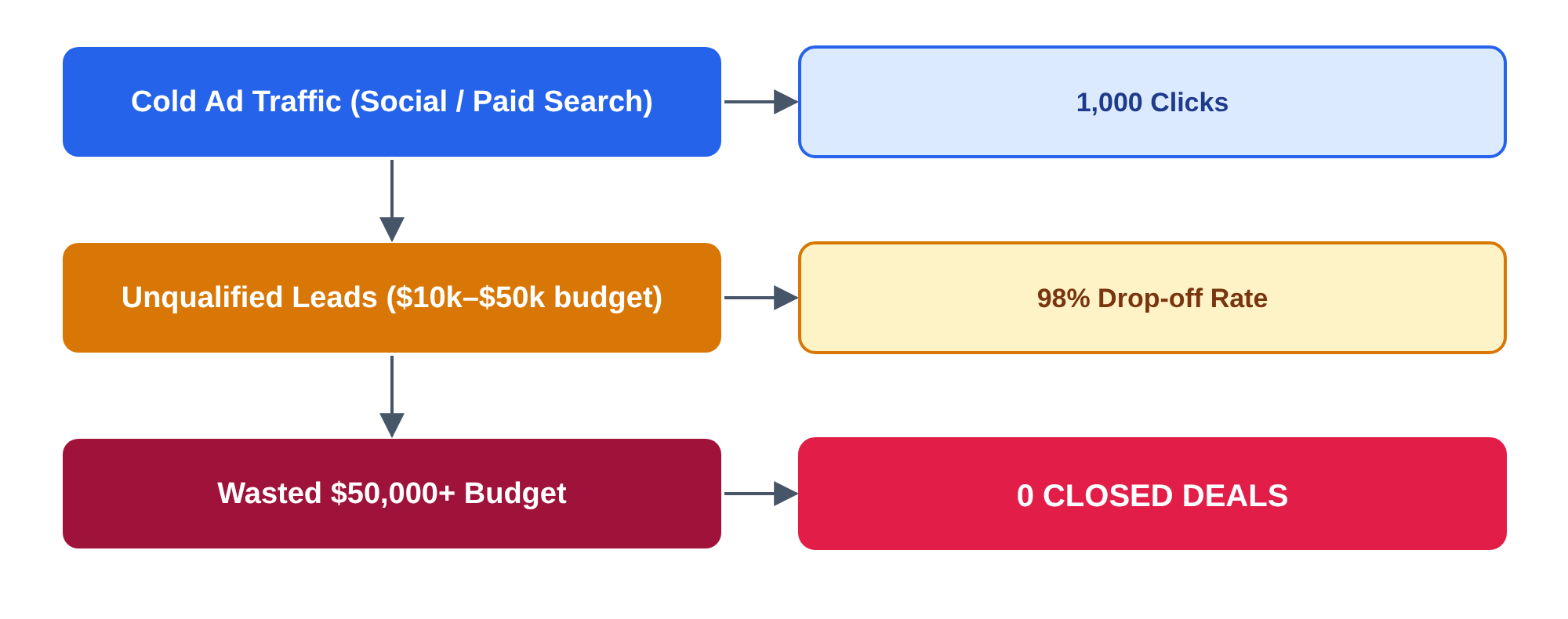
Common pitfalls when launching international campaigns:
- Targeting Cold Audiences via Direct Ads: Investors managing $5M+ portfolios do not fill out social media lead forms. Customer acquisition costs (CAC) for cold digital leads range from $150 to $300 per submission, with 98% of incoming traffic lacking the requisite capital.
- Bypassing Local Intermediary Networks: Attempting to sell projects directly without engaging immigration attorneys, tax advisors, and family offices damages credibility. Paying agent commissions of 3%–5% on raised capital fully offsets acquisition costs by radically reducing conversion friction.
- Omitting the Lead Nurturing Phase: Committing $800,000 takes 3 to 9 months of consideration. Companies that abandon prospect follow-ups after 2 or 3 cold calls lose their target audience during the initial information-gathering phase.
The High-Yield Nurturing Framework: Multi-Touchpoint Closing
High-ticket investments close after prospects complete 8 to 12 structured touchpoints. An effective operational model combines regular content marketing, expert online sessions, and intimate offline gatherings.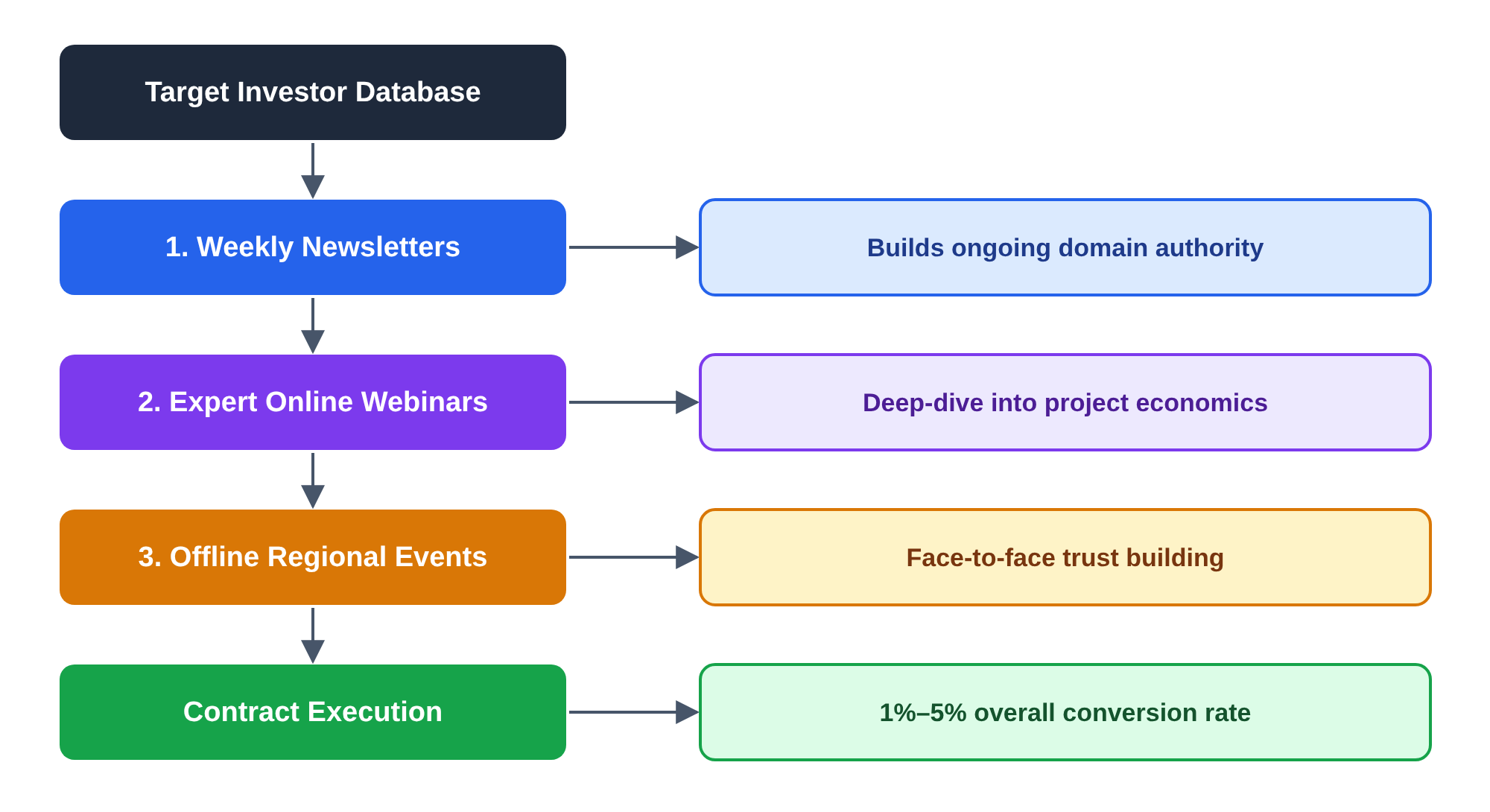
An optimized marketing funnel includes:
- Analytical Newsletters: Weekly breakdowns covering market insights, regulatory updates (such as EB-5 reform updates or UAE tax code changes), and project financial reports. This establishes domain authority and keeps your brand top-of-mind.
- Private Webinars: Hosting monthly online deep-dives featuring guest immigration attorneys and project developers. This format attracts 30 to 100 registered attendees ready for detailed discussions.
- Intimate Offline Gatherings: Organizing private dinners or executive breakfasts for 15 to 30 guests in key financial hubs (Dubai, Almaty, Tashkent, Mumbai). Staging an event costs between $5,000 and $10,000. In-person interactions deliver the highest conversion rates: a well-executed event consistently yields 1 to 3 closed deals.
Economics of Acquisition & ROI Summary
Investment marketing is evaluated on the overall Cost of Capital Acquisition.
| Cost Item | Cold Performance Ads | Systemic Nurturing |
|---|---|---|
| Annual Budget | $60,000 | $64,000 |
| Execution Mix | Paid Social / Search | Newsletters, 12 webinars, 4 offline events |
| Qualified Leads | 200–300 (Low intent) | 500–1,600+ (High) |
| Closed Transactions | 0 – 1 | 5 – 10+ |
| Capital Raised | $0 – $800,000 | $4,000,000–$8,000,000 |
Raising capital for EB-5 projects or high-end real estate generates an Administrative Fee (Admin Fee) of $70,000 to $80,000 per closed investor, in addition to developer margins.
Closing a single $800,000 transaction per year completely covers the annual marketing retainer and event operational expenses. Securing subsequent contracts generates pure profit while establishing an enduring partner network for future project launches.
Direct human interaction, transparent numbers, and genuine respect for regional nuances ensure long-term, scalable market presence across global capital markets.
This material is for general information only and does not constitute legal, immigration, investment, or tax advice. Program requirements and processing practices may change. Individual results depend on the applicant’s circumstances, visa availability, USCIS decisions, and project performance.