
Regulation and Institutional Framework
The regulatory framework determines the strength of property rights protections and the volume of mandatory owner expenses.
United States of America
The U.S. market provides a classic institutional environment with high legal protections. Property law is governed primarily at the individual state and municipal levels.
Investors operate under total tax oversight from the Internal Revenue Service (IRS). Purchasing property triggers an ongoing annual property tax liability. Local authorities establish these rates, which average between 0.8% and 2.5% of the property's assessed value. Payments are required regardless of whether the asset generates rental income. All real estate transactions are recorded in public registries, providing full transparency on historical property ownership and operations.
United Arab Emirates
Real estate markets in Dubai and other emirates function under codification established by the Dubai Land Department (DLD) and the Real Estate Regulatory Authority (RERA). Designated free zone financial centers utilize legal systems modeled on English common law.
UAE legislation protects off-plan buyer funds through mandatory escrow accounts. Developers receive access to investor funds in tranches aligned with verified construction milestones. Local government authorities levy no annual property ownership taxes. Buyers pay a one-time 4% Dubai Land Department fee upon transfer of title. Acquiring real estate valued at 2 million AED or higher qualifies investors to apply for a long-term ten-year residency visa.
Economic Indicators and Financial Instruments
Financial returns depend on net rental cash flows and underlying property value changes over time.
U.S. Market Financial Parameters
Gross rental yields across major U.S. metropolitan areas remain moderate, ranging from 3% to 5% annually. Operating expenses—including property management fees, property insurance, home owners association (HOA) dues, and annual municipal taxes—are deducted from gross income. As a result, net rental yields settle between 2% and 3.5% per year.
Foreign investors can secure mortgage financing through U.S. lending institutions by placing a down payment between 30% and 40%. The U.S. housing market demonstrates a consistent historical rate of property value appreciation between 3% and 5% annually.
UAE Market Financial Parameters
Rental cash flows in Dubai produce elevated yield metrics. Gross rental rates range between 6% and 9% per year. The absence of recurring property taxes allows net yields to remain between 5% and 7% annually after deducting common area maintenance (service charges).
Real estate developers in the UAE offer interest-free payment plans spanning construction periods and post-handover schedules. Initial down payments for off-plan property purchases range from 10% to 20%. The UAE real estate market experiences wider price fluctuation cycles alongside periods of rapid capital growth.
Factors Driving U.S. Real Estate Ownership
Investing in U.S. real estate involves several distinct operational characteristics.
Positive Factors in U.S. Investment
The U.S. real estate market maintains substantial liquidity and transaction volume. Selling a well-located asset occurs within predictable timeframes at prevailing market valuations.
The U.S. judicial system provides direct enforcement of property ownership rights. Statutory laws ensure compliance with purchase agreements and lease contracts. All income is denominated in U.S. dollars, insulating capital from foreign exchange fluctuations.
Holding Costs and Institutional Considerations in the U.S.
Property ownership in the U.S. involves continuous financial obligations. Annual property taxes and legal fees reduce overall net profitability.
Tenancy laws in certain states include robust tenant protections. Specific metropolitan markets enforce rent control restrictions and complex eviction procedures that extend timelines for resolving non-payment issues. Foreign investors must file annual tax returns with federal and state revenue authorities.
Factors Driving UAE Real Estate Ownership
The UAE market offers real estate investors an environment structured around low tax friction.
Positive Factors in UAE Investment
The Emirati market provides significant tax efficiency. The absence of personal income tax and capital gains tax allows investors to retain gross operational returns.
The national currency (AED) is pegged directly to the U.S. dollar at a fixed exchange rate. This structure eliminates currency conversion risks for U.S. dollar-denominated capital. RERA applies clear enforcement mechanisms against lease violations, allowing landlords to repossess property through expedited formal notices. Investors can access developer installment plans without entering formal bank financing.
Holding Costs and Institutional Considerations in the UAE
High rates of new housing deliveries generate periodic supply surpluses in localized submarkets. Increased inventory puts downward pressure on rental rates in high-density development zones.
The national economy relies on foreign labor inflows and external capital allocation. Shifts in global macroeconomic trends impact local demand directly. The region's extreme heat and humidity accelerate building wear and tear, requiring ongoing maintenance expenditures for HVAC and cooling infrastructure.
Practical Investor Action Plan
Efficient capital placement requires executing a structured operational sequence.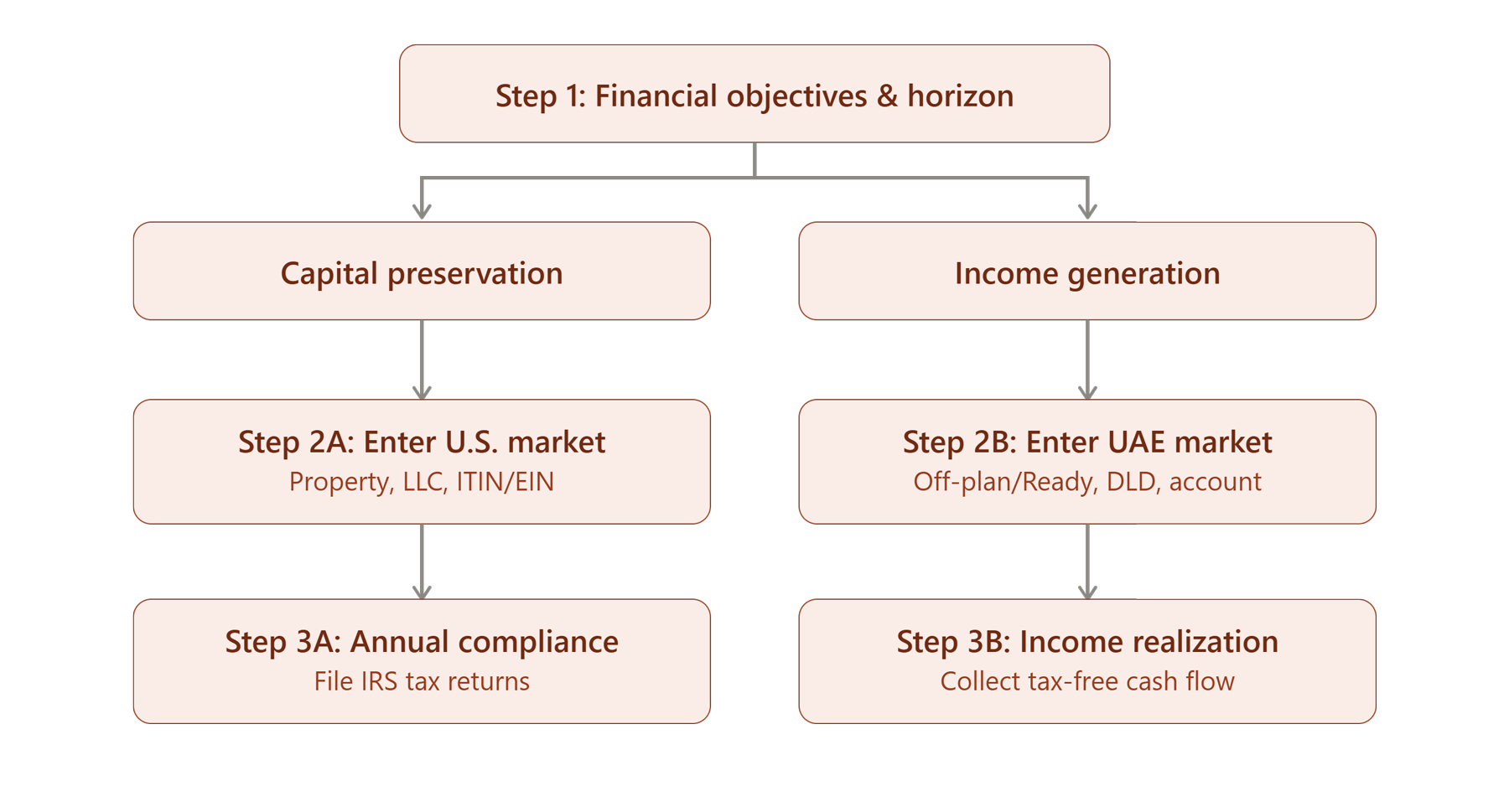
-
Establish Investment Strategy. Define capital distribution targets, selecting between high operational cash flow and long-term asset appreciation.
-
Execute Legal Setup. For U.S. acquisitions, register a Limited Liability Company (LLC) and obtain an Individual Taxpayer Identification Number (ITIN) or Employer Identification Number (EIN). For UAE transactions, open a local bank account and register with the Dubai Land Department.
-
Conduct Due Diligence. Audit developer financial capacity in the UAE or order a professional physical building inspection in the U.S.
-
Complete Closing. Wire funds into a designated developer escrow account or a licensed settlement company escrow account.
-
Appoint Property Management. Engage an accredited property management firm to handle tenant placement and facility operations.
Capital Allocation Principles
The U.S. and UAE real estate markets fulfill different functions within a global portfolio. U.S. real estate serves as an anchor asset for preserving capital over ten to twenty-year horizons within a mature legal environment. UAE real estate operates as a yield generator, producing currency-denominated cash flow without local tax drag. Combining both asset classes provides effective diversification while managing overall market risk.
This material is for general information only and does not constitute legal, immigration, investment, or tax advice. Program requirements and processing practices may change. Individual results depend on the applicant’s circumstances, visa availability, USCIS decisions, and project performance.