
When evaluating this program, the primary consideration is the deployment channel for capital. Historically, two primary pathways exist: direct investment into a self-managed enterprise or participation through specialized institutions. EB-5 Regional Centers serve as the primary professional link connecting private investors with commercial real estate and infrastructure developments. They pool capital, structure transactions legally, and ensure ongoing regulatory compliance.
The system of a Regional Center: Structure and Functions
Legally, an EB-5 Regional Center is a public or private entity designated by U.S. Citizenship and Immigration Services (USCIS) to manage economic development projects within the program. Its primary function is to aggregate capital from multiple investors and deploy it into a New Commercial Enterprise (NCE). The NCE then provides a loan or equity investment to a Job Creating Entity (JCE), which directly executes the underlying project.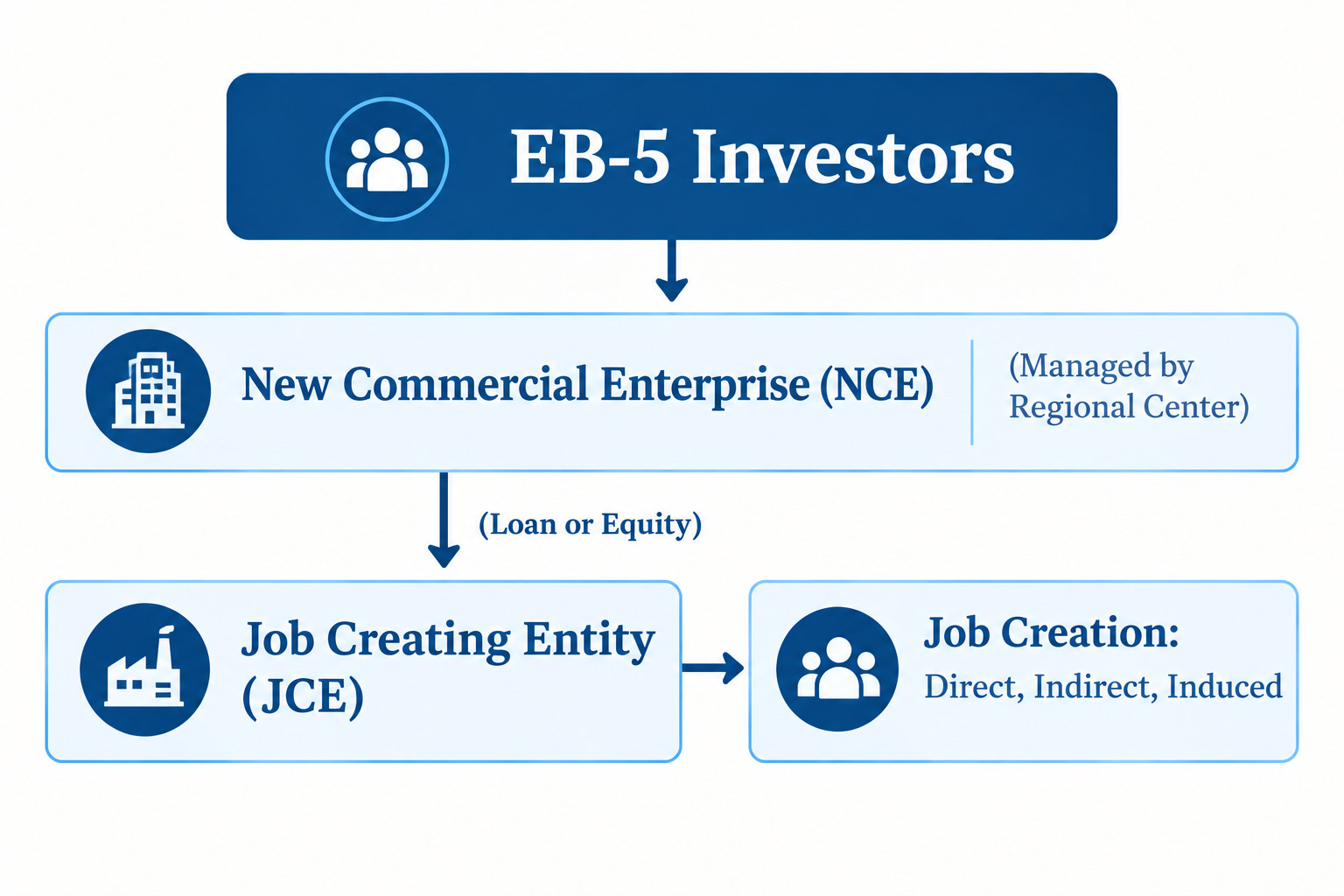
Pooling capital enables the formation of large credit facilities required for institutional-scale developments: commercial complexes, logistics hubs, or public infrastructure. For an individual participant, this structure grants access to institutional-grade deals managed by professionals without requiring day-to-day operational management of the business.
The core distinction between direct investments and EB-5 Regional Centers involves the methodology used to calculate job creation. Direct investments require proving the creation of ten direct, full-time W-2 employees on the enterprise's payroll. Regional Centers are permitted to utilize economic models to count direct, indirect, and induced jobs. Indirect jobs are created within supply chains, while induced jobs result from employee spending in the local economy. This methodology substantially reduces execution risk regarding the core immigration requirement.
Project Selection and Structuring (TEA and the 2022 RIA Reform)
Project location and local economic conditions dictate the minimum capital commitment required. Federal law establishes Targeted Employment Areas (TEAs), which encompass rural areas or locations experiencing unemployment at least 150% of the national average. Projects within a TEA qualify for a reduced minimum investment threshold of $800,000, compared to $1,050,000 for non-TEA projects.
The EB-5 Reform and Integrity Act of 2022 (RIA) marked a major evolution in program governance. This legislation restructured oversight and risk management protocols, creating greater transparency for all participants:
-
Enhanced Oversight: USCIS gained expanded audit authority over Regional Centers, including mandatory site visits and stricter scrutiny of capital source documentation.
-
Investor Protections: Institutional safeguards were established to protect investors from project disqualification resulting from Regional Center missteps, provided the investor remains compliant.
-
Operational Transparency: New standards mandate segregated bank accounts, regular financial disclosures, and registration of third-party promoters.
-
Set-Aside Visa Categories: Statutory reserves were created for specific project types: rural developments (20%), high-unemployment areas (10%), and infrastructure projects (2%).
Systemic Risk Analysis for Investors
Every EB-5 investment carries two distinct yet interconnected categories of risk: immigration risk and financial risk. Evaluating these factors objectively allows investors to assess probability-weighted outcomes accurately. 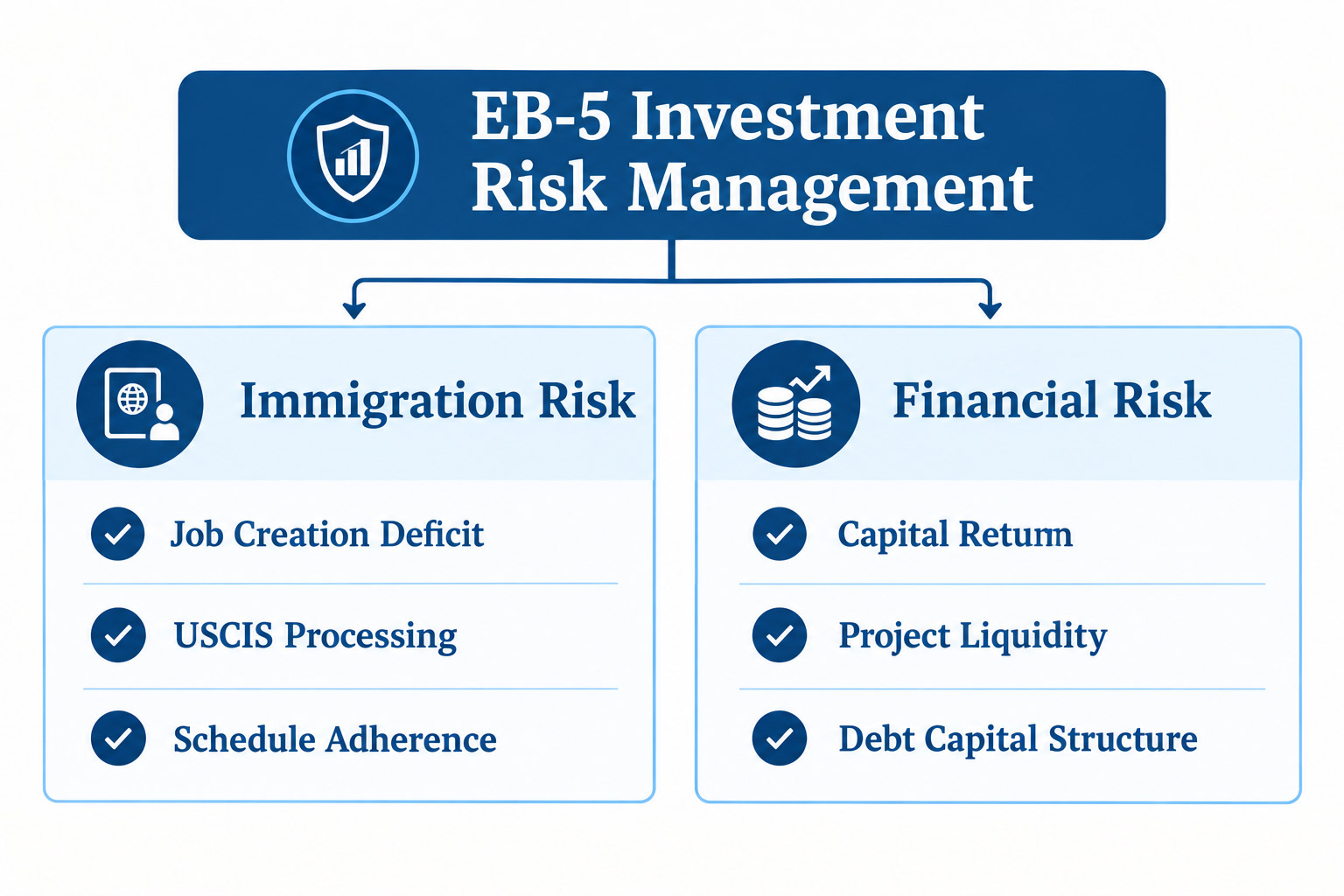
Immigration Risk
Immigration risk involves the potential denial of Form I-526E (Immigrant Petition by Regional Center Investor) or Form I-829 (Petition by Investor to Remove Conditions on Permanent Resident Status). The primary driver of immigration risk is failing to meet the mandate of creating ten full-time jobs per investor.
To mitigate this risk, experienced Regional Centers build a "job cushion" into their economic models—aiming to create 20% to 50% more jobs than the statutory minimum. This buffer insulates investors from macroeconomic downturns during construction or initial operations.
Financial Risk
USCIS regulations dictate that invested capital must remain fully "at risk" throughout the conditional residency period. Unconditional guarantees of return by government or banking entities are legally prohibited. Consequently, capital preservation and return depend entirely on the underlying project's solvency and asset liquidity.
Evaluating financial risk requires analyzing the following structural elements:
-
EB-5 Capital Stack Percentage: A conservative target for EB-5 capital is 15% to 30% of total project costs. A meaningful equity contribution by the developer (20% or higher) aligns developer incentives with investor outcomes.
-
Financing Structure: Senior or mezzanine debt structures with defined maturity dates provide clearer exit timelines than common equity positions.
-
Collateral and Liens: First or second mortgage positions on real property or project assets offer tangible downside protection.
-
Exit Strategy: Clear identification of capital repayment sources upon loan maturity—whether through asset refinancing, property sale, or operational cash flow.
Fact-Based Decision Making
A disciplined approach to selecting a Regional Center relies on historical metrics and track record verification. Objective evaluation requires reviewing several key criteria:
-
Historical Track Record: Operating history, total completed developments, and demonstrated capital repayment history to past investors.
-
USCIS Approval Rates: Approval history for Forms I-526/I-526E and Form I-829. A strong record of approvals indicates sound legal drafting and realistic economic modelling.
-
Developer Reputation: Developer experience within the specific asset class, past execution success, and access to institutional capital markets.
-
Reporting Transparency: Willingness of the manager to provide independent audit statements, progress reports, and construction updates.
The EB-5 program is a multi-year process where proper due diligence, transaction structuring, and institutional selection determine capital preservation and successful immigration outcomes.
This material is for general information only and does not constitute legal, immigration, investment, or tax advice. Program requirements and processing practices may change. Individual results depend on the applicant’s circumstances, visa availability, USCIS decisions, and project performance.