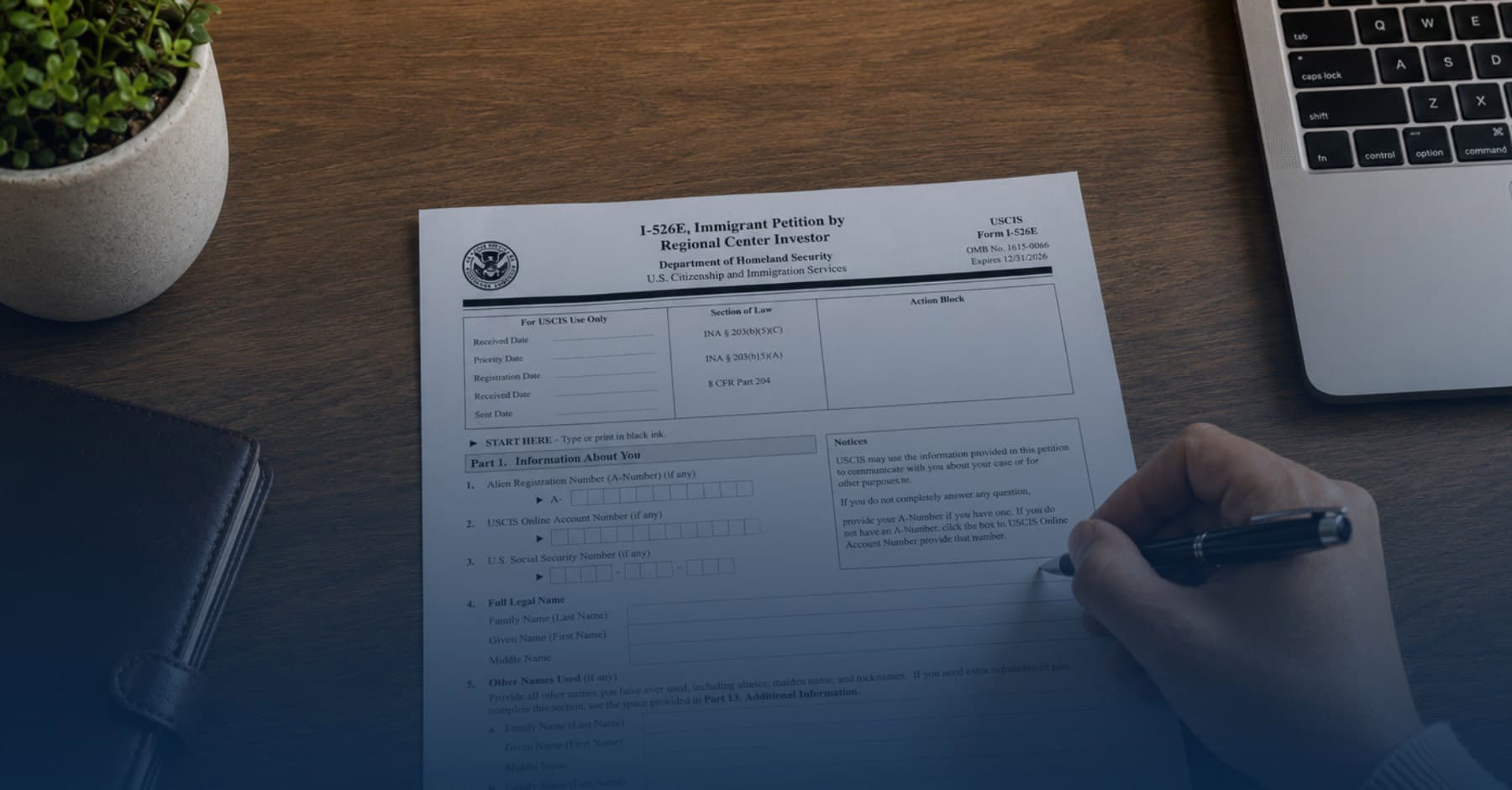
The Purpose and Legal Status of Form I-526
Form I-526 is the foundational petition submitted to United States Citizenship and Immigration Services (USCIS). Filing this document formally establishes the intent of the investor and their immediate family (spouse and unmarried children under 21) to obtain US immigrant visas.
The EB-5 Reform and Integrity Act of 2022 (RIA) split the initial petition into two separate forms:
-
Form I-526 (Immigrant Petition by Standalone Investor): Used for direct investments. The investor invests directly into their own or an existing new commercial enterprise (NCE) and actively manages its operations.
-
Form I-526E (Immigrant Petition by Regional Center Investor): Used when investing through an EB-5 Regional Center. This route allows the project to count direct, indirect, and induced jobs toward the creation requirement.
Both forms serve the same legal purpose: confirming the investor’s eligibility for a conditional US Green Card, provided all program criteria are met.
Three Primary Approval Criteria
USCIS evaluates petitions based on whether the supporting evidence meets established legal standards. Decisions are made by analyzing three core criteria.
1. Lawful Source of Funds
The applicant must prove the legal origin of their EB-5 investment capital. This requires tracing the complete capital path from its point of origin to its transfer into the escrow account or the commercial enterprise’s bank account.
Acceptable sources of capital include:
-
Business income or corporate dividends.
-
Salary, wages, and executive bonuses.
-
Proceeds from the sale of real estate or other assets.
-
Inherited assets or gifted funds (requiring proof of the donor’s lawful source of income).
-
Loan proceeds secured by the investor’s personal assets.
USCIS verifies tax compliance on these funds as well as financial transaction records across all intermediate accounts.
2. Investment Amount and Targeted Employment Area (TEA) Status
Minimum investment thresholds are fixed by law and depend on the geographic location of the project:
-
$800,000 — For investments in a Targeted Employment Area (TEA). TEAs include rural areas with a population under 20,000 or high-unemployment areas with an unemployment rate at least 150% of the national average.
-
$1,050,000 — For investments in non-TEA projects (standard investment amount).
The investor must provide banking documentation showing that the full required amount has been deployed into the project or held in an escrow account, fully committed to executing the business plan.
3. Job Creation (10 Full-Time Jobs)
Each investor must fund the creation of at least 10 full-time jobs (minimum 35 hours per week) for qualifying US workers (US citizens or lawful permanent residents).
-
Direct Investments (Form I-526): Only direct W-2 employees hired directly by the enterprise count toward the requirement, as verified by payroll and tax filings.
-
Regional Center Investments (Form I-526E): Job creation is calculated using approved economic methodology models (e.g., IMPLAN or RIMS II). These models account for indirect and induced job creation resulting from capital expenditure and construction activities.
Required Documentation Package
Applicants assemble a comprehensive petition package divided into three main categories: personal documentation, financial proof for source of funds, and project-level documentation.
Personal Documents (Investor and Dependents)
-
Copies of passports and birth certificates.
-
Marriage certificates or divorce decrees.
-
Police clearance certificates from countries of residence.
-
Copies of previously issued US visas or immigration records.
Financial Documents (Source of Funds)
-
Personal and corporate tax returns for the past 5 years.
-
Bank statements covering the entire period of capital accumulation and wire transfers.
-
Audited financial statements, asset sale agreements, and real estate closing documents.
-
Deed of gift agreements, loan agreements, and ownership records for collateral assets.
-
Receipts, wire transfer confirmations, and SWIFT slips showing the complete trail of funds.
Project Documents
-
A Matter of Ho-compliant business plan (including financial projections, market analysis, and a hiring schedule).
-
An economic impact report calculating job creation (for Form I-526E).
-
Form I-956F approval (USCIS project approval for Regional Centers).
-
NCE/JME organizational documents (Limited Partnership Agreement, Operating Agreement, Loan Agreement, Private Placement Memorandum).
-
Escrow Agreement.
Processing Times and Associated Costs
Filing and processing an EB-5 petition involves gathering documentation, retaining professional services, and paying statutory filing fees.
Financial Breakdown
|
Expense Item |
Fee / Cost |
Notes |
|---|---|---|
|
Form I-526 / I-526E Filing Fee |
$11,160 |
Paid to USCIS |
|
EB-5 Integrity Fund Fee |
$1,000 |
Required for I-526E filings |
|
Premium Processing Fee |
$2,805 |
Available for designated rural TEA petitions |
|
Immigration Attorney Legal Fees |
$25,000 – $40,000 |
Varies based on the complexity of the Source of Funds |
|
Regional Center Administration Fee |
$50,000 – $80,000 |
Retained by the developer / Regional Center |
I-526 Processing Times
USCIS processing periods vary depending on project classification and the investor's country of chargeability:
-
Rural TEA Projects: Granted priority processing status under the 2022 RIA. Average processing times range from 6 to 12 months.
-
High-Unemployment and Standard Projects: Average processing times range from 24 to 48 months.
Investors from visa-backlogged countries (such as China or India) may experience additional wait times due to annual visa limits.
Consequences of Approval or Denial
A decision issued by USCIS regarding Form I-526/I-526E dictates the next legal steps for the investor and their family.
Petition Approval
An approved Form I-526 confirms that the investor and the project meet all statutory immigration requirements. Approval does not grant immediate entry into the US, but it opens the path to lawful permanent resident status:
-
If the investor is outside the US: The case is forwarded to the National Visa Center (NVC). The investor completes consular processing, attends an interview at a US embassy or consulate, and receives an EB-5 immigrant visa. Upon entering the United States, a 2-year conditional Green Card is issued.
-
If the investor is inside the US on a valid visa: The investor files Form I-485 (Adjustment of Status) to adjust their status locally without leaving the country.
-
Form I-829 Filing: Within the 90-day window before the 2-year conditional Green Card expires, the investor files Form I-829 to remove conditions and obtain a permanent 10-year Green Card.
Petition Denial
If USCIS has concerns regarding a petition, it issues a Request for Evidence (RFE) or a Notice of Intent to Deny (NOID). The applicant is given 30 to 90 days to submit additional arguments and supporting documentation.
If a final denial is issued:
-
The investor can file an appeal with the Administrative Appeals Office (AAO) or file a lawsuit in US Federal District Court.
-
For Regional Center investments, funds held in escrow are refunded according to the terms of the Escrow Agreement.
The investor retains the right to reapply after curing the deficiencies that led to the denial.
This material is for general information only and does not constitute legal, immigration, investment, or tax advice. Program requirements and processing practices may change. Individual results depend on the applicant’s circumstances, visa availability, USCIS decisions, and project performance.