
Traditional institutional lenders have scaled back Loan-to-Value (LTV) and Loan-to-Cost (LTC) ratios from historical levels of 70–75% down to 50–55%, unlocking a high-yield window for mezzanine and preferred equity capital providers.
The Compression of Bank Leverage: Mechanics Behind the LTV and DSCR Shift
The U.S. banking sector has adopted conservative collateral valuations. While lenders routinely funded up to 75% of development project budgets through Senior Debt during the zero-interest-rate era, current market average LTC ratios have settled at 50–55%.
Concurrently, banks have raised minimum Debt Service Coverage Ratio (DSCR) requirements from 1.20x–1.25x to 1.35x–1.50x.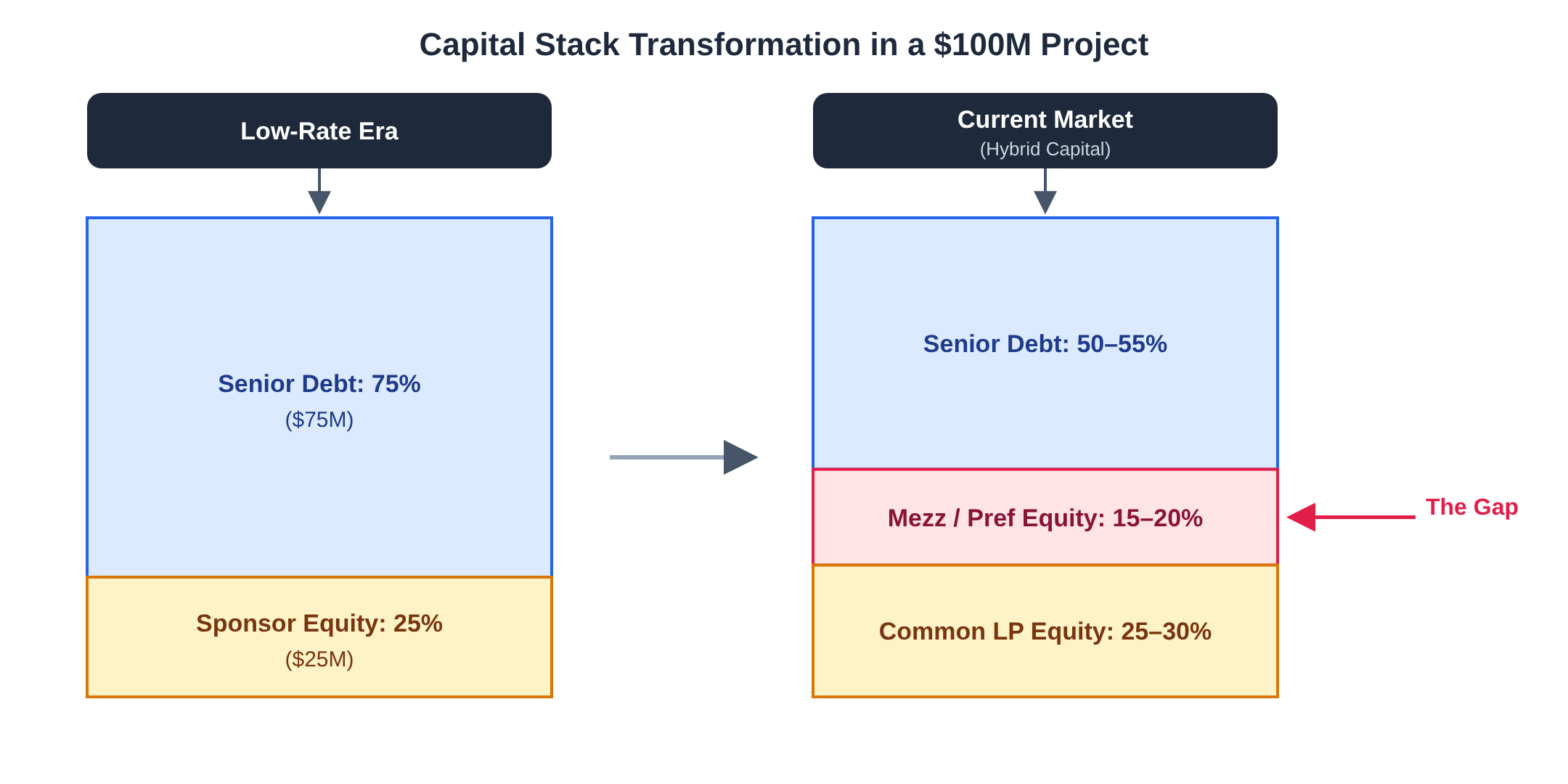
Elevated DSCR thresholds stem directly from higher borrowing costs: benchmark SOFR (Secured Overnight Financing Rate) plus lender spreads hold senior debt rates between 7.0% and 8.5% annually. Developers attempting to plug the remaining budget deficit using pure sponsor equity face severe compression on Return on Equity (ROE).
To bridge this 20–25% Capital Gap, deal sponsors are turning to hybrid capital structures.
Anatomy of the Modern Capital Stack
Financing for premier U.S. development projects now relies on a three-tiered hierarchical capital stack:
|
Capital Tier |
Budget Share (LTC) |
Expected Return |
Primary Protection Mechanism |
|---|---|---|---|
|
Senior Debt |
50% – 55% |
7.0% – 8.5% (Floating/Fixed) |
First Mortgage Lien |
|
Mezzanine / Preferred Equity |
15% – 20% |
10.0% – 13.0% (Current/Accrued) |
Second Lien / Pledge of SPV Shares |
|
Common LP Equity |
25% – 30% |
18.0% – 22% Target IRR |
Share of Net Profits (Waterfall) |
1. Senior Debt
Provided by commercial banks (e.g., Wells Fargo, Bank of America), insurance companies, or private debt funds. Senior debt maintains absolute priority for interest payments and principal recovery, funding the primary 50–55% of acquisition and construction expenditures.
2. Mezzanine Debt / Preferred Equity
Bridges the gap between senior bank debt and common equity. Preferred equity investors receive a fixed coupon yield (typically 8–10% cash-on-cash current pay plus 2–3% Payment-in-Kind / PIK accrued interest). This layer is cushioned by 25–30% sponsor and LP common equity underneath it.
3. Common LP Equity
Sourced from High-Net-Worth Individuals (HNWIs) and family offices. While lacking a fixed coupon, common equity absorbs the majority of net operational cash flows and capital appreciation upon exit once senior and intermediate obligations are satisfied.
Strategic Entry Points for Private Capital
International investors leverage the flexibility of U.S. legal frameworks to select their risk-return profile within Special Purpose Vehicle (SPV) entities.
Strategy A: Preferred Equity (Protected Fixed Yield)
Targeted at investors prioritizing capital preservation. Preferred equity sits senior to developer equity, holding first-dollar rights to operational Cash Flow distributions before the developer participates in profits.
In the event of sponsor default, the Operating Agreement grants preferred equity investors the right to remove the General Partner (GP) and assume operational control of the asset. Current risk-adjusted returns range from 10% to 13% annually in USD.
Strategy B: Common LP Equity (Upside Participation)
Investors join the Limited Partner pool to capture upside from asset appreciation and net margin expansion. Upon market stabilization and successful project execution, target returns range between 18% and 22% IRR, with Equity Multiples of 1.8x–2.2x over a 4-to-5-year holding period.
Financial Engineering and Volatility Risk Management
Deploying capital within hybrid structures requires rigorous stress testing and clear intercreditor governance.
1. Stress-Testing Exit Capitalization Rates (Exit Cap Rates)
Financial modeling must account for potential cap rate expansion upon asset stabilization. If current market cap rates stand at 5.0%, conservative underwriting projects Exit Cap Rates at 5.75%–6.25% to insulate returns against potential declines in terminal property valuations during refinancing or sale.
2. Intercreditor Agreements
The legal relationship between the Senior Lender and Preferred Equity / Mezzanine investors is governed by an Intercreditor Agreement. Key protective provisions include:
- Cure Rights: The right of intermediate capital holders to cure senior debt defaults on behalf of the sponsor to prevent foreclosure.
- Buyout Rights: The option to purchase the senior mortgage position at par value to protect the underlying equity position in adverse scenarios.
3. Profit Distribution Mechanics (Waterfall)
The Operating Agreement establishes the order of distributions via a structured Waterfall:
- Return of Capital: 100% of available cash flows are allocated toward reimbursing LP principal.
- Preferred Return: Distribution of an agreed hurdle rate (typically 8% per annum) to LP investors.
- GP Catch-Up / Carried Interest: Distribution of residual profits (typically split 70/30 or 80/20 in favor of LPs) until target IRR thresholds are met.
Leveraging hybrid capital frameworks allows investors to construct balanced U.S. real estate portfolios, combining bank-grade downside security with equity-level upside potential.
This material is for general information only and does not constitute legal, immigration, investment, or tax advice. Program requirements and processing practices may change. Individual results depend on the applicant’s circumstances, visa availability, USCIS decisions, and project performance.