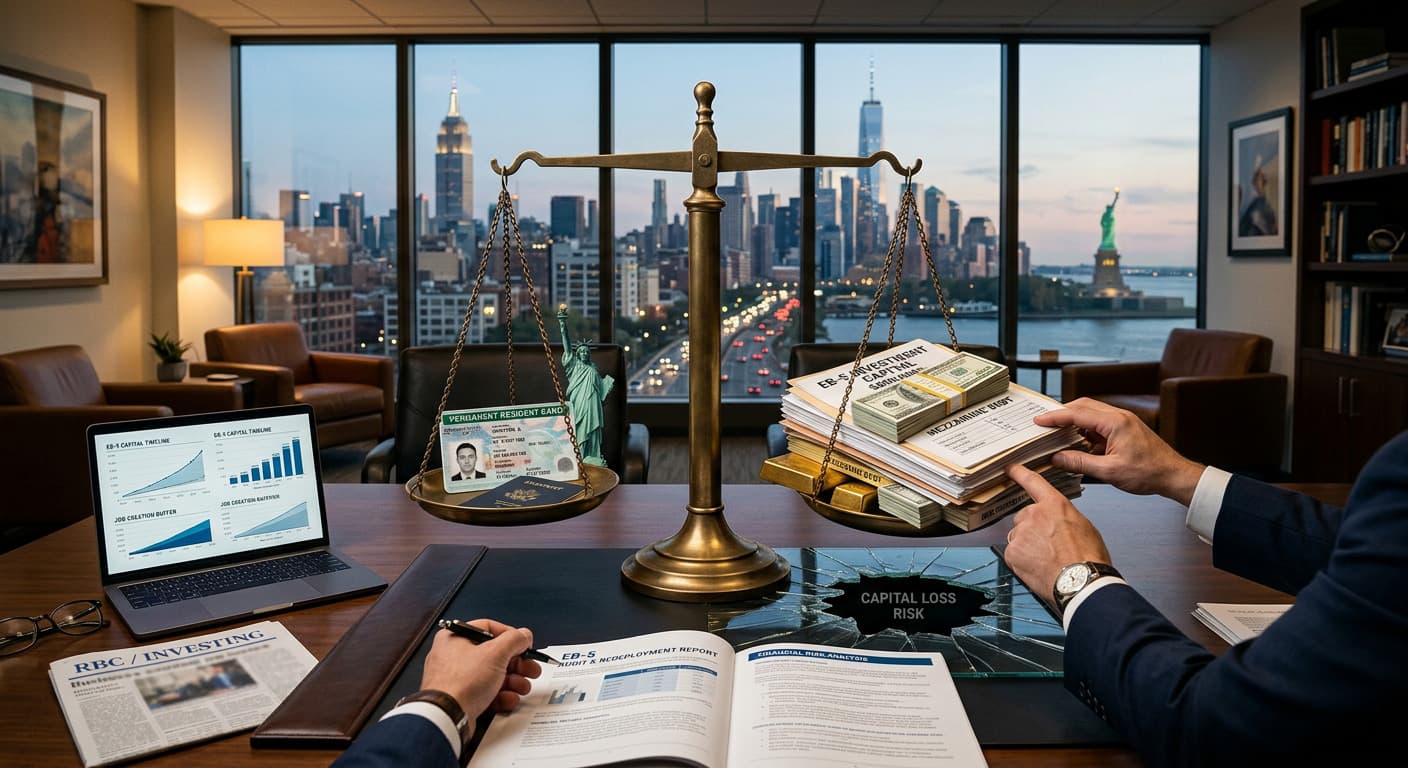
In private wealth management, an EB-5 investment is best understood as asset-backed debt financing extended to U.S. real estate developers—featuring fixed principal repayment terms alongside permanent U.S. immigration status for the investor’s family.
The 2022 RIA Legal Framework and Rural TEA Advantages
The EB-5 Reform and Integrity Act (RIA) of 2022 codified USCIS’s institutional priorities by establishing reserved visa categories (set-asides). These allocate 32% of the annual 10,000 EB-5 visa cap across three specific project types:
- 20% (2,000 visas): Rural Targeted Employment Areas (Rural TEA).
- 10% (1,000 visas): High Unemployment Areas (Urban TEA).
- 2% (200 visas): Infrastructure Projects.
| Project Category | Share of Total Annual EB-5 Cap |
|---|---|
| Rural Areas (Rural TEA) | 20% (2,000 visas / year) |
| High Unemployment (Urban TEA) | 10% (1,000 visas / year) |
| Infrastructure Projects | 2% (200 visas / year) |
| Unreserved Category | 68% (6,800 visas / year) |
Rural TEA projects offer two distinct regulatory advantages. The first is Priority Processing for Form I-526E petitions. Average adjudication times for Rural TEA I-526E petitions range between 6 and 12 months, compared to 24 to 48 months for urban (Urban TEA) projects.
The second advantage is the absence of country backlog queues. Applicants from high-demand countries like China and India facing Urban TEA backlogs often wait 5 to 10 years due to the 7% per-country cap. In contrast, the Rural TEA reserved category remains current, enabling immediate visa issuance upon I-526E approval.
Furthermore, investors residing in the U.S. under non-immigrant visas (F-1 student, H-1B work, L-1 corporate transferee, O-1 extraordinary ability) can utilize Concurrent Filing. This allows simultaneous submission of Form I-526E and Form I-485 (Adjustment of Status), securing an Employment Authorization Document (EAD) and Advance Parole travel permit within 3 to 6 months—legally protecting their physical stay in the U.S. while awaiting permanent residency approval.
Capital Protection & Financial Architecture
EB-5 investments made via Regional Centers are typically structured as Mezzanine Debt or Senior Debt. The Regional Center establishes a fund—the New Commercial Enterprise (NCE)—which pools investor capital and extends a loan to the project developer’s operating entity, the Job Creating Entity (JCE).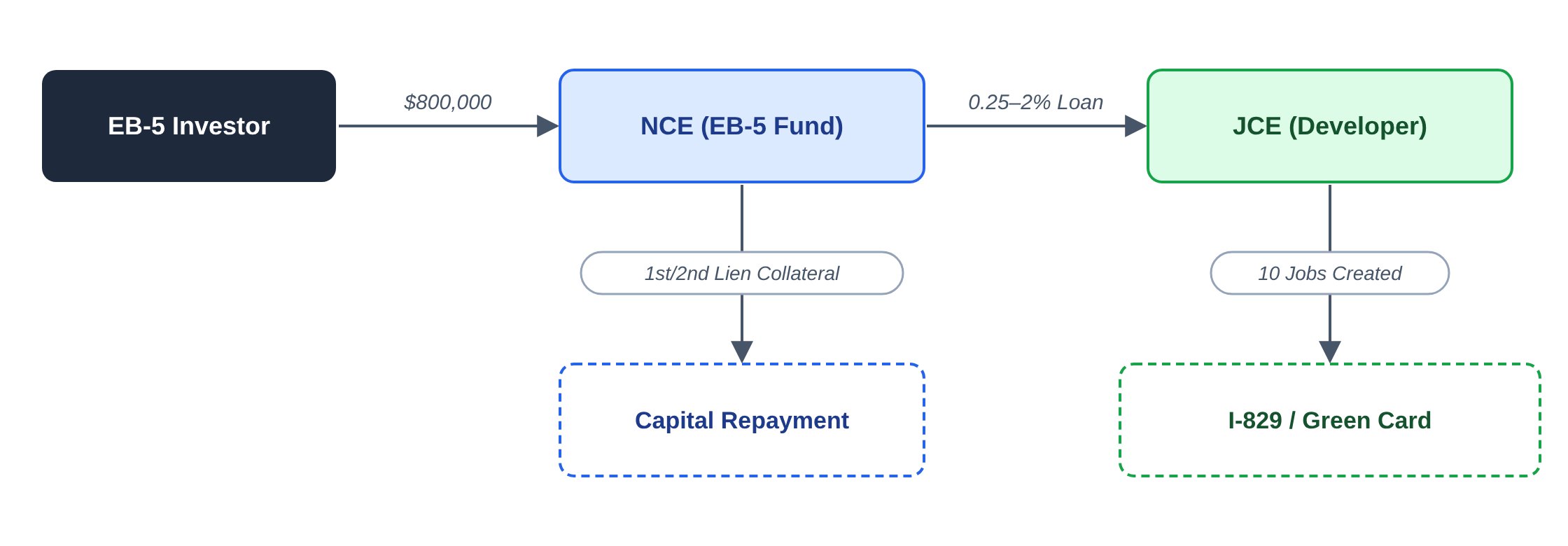
A standard real estate project capital stack is structured as follows:
- Senior Bank Debt: 50%–60% of total project cost.
- EB-5 Capital (Mezzanine Loan): 10%–30% of total project cost.
- Developer Equity: 15%–25% of total project cost.
The developer pays an annual interest rate of 4%–8% for EB-5 capital, from which the investor receives a modest preferred coupon yield of 0.25%–2.0%. The investor's primary financial goal is not speculative return, but the full preservation and return of the $800,000 principal at the end of the loan term (typically 4–5 years with 1–2 year extension options).
To insulate investor capital from credit risks, institutional deals employ clear collateral mechanisms:
- First or Second Lien Collateral: Securing mortgages or pledges against project land, under-construction real estate, or equity shares of the developer’s parent company.
- Completion Guarantees: Enforceable commitments by the developer or parent entity to fund cost overruns and complete construction using corporate balance sheet capital.
- Loan-to-Value (LTV) Caps: Ensuring combined leverage (Senior Debt + EB-5) does not exceed 70%–75% of the independent, post-completion stabilized appraised value.
- I-526E Repayment / Refinancing Terms: Contractual provisions mandating loan refinancing or principal redemption if an investor's I-526E petition is denied by USCIS.
Project & Developer Due Diligence Framework
Prior to transferring funds into escrow, investors must conduct rigorous due diligence across three core deal participants: the developer, the Regional Center, and the underlying real estate asset.
| Audit Subject | Key Criteria & Benchmark Requirements |
|---|---|
| Developer | 10+ year track record, zero defaults, Equity >15–20% |
| Regional Center | Active USCIS designation, I-829 approval & exit history |
| Senior Debt | Executed bank loan commitment, fully permitted site |
| Job Creation | >20% job buffer (12+ jobs created per investor) |
Key evaluation criteria include:
- Developer's Equity ("Skin in the Game"): Developer cash equity must account for at least 15%–20% of the total capital stack. Unlevered equity absorbs first-dollar losses if market valuations decline.
- Institutional Senior Financing Status: Presence of a fully executed Senior Bank Loan Commitment. Independent underwriting by an institutional bank validates the feasibility of the project's financial model.
- Job Cushion Margin: USCIS mandates that each investor create at least 10 full-time jobs. These are calculated using economic input-output models (such as RIMS II or IMPLAN) based on hard construction expenditures. A resilient deal maintains a job cushion of 12 to 15 jobs per investor (a 20%–50% safety buffer), ensuring full immigration compliance even if construction spending drops by 20%.
- Regional Center Track Record: Verifying an active USCIS designation in good standing, clean regulatory records with the SEC, and a proven history of I-829 approvals and full principal capital returns across prior project vintages.
Step-by-Step Investment & Immigration Roadmap
The pathway to securing an Unconditional U.S. Green Card through the EB-5 program follows four distinct operational phases. 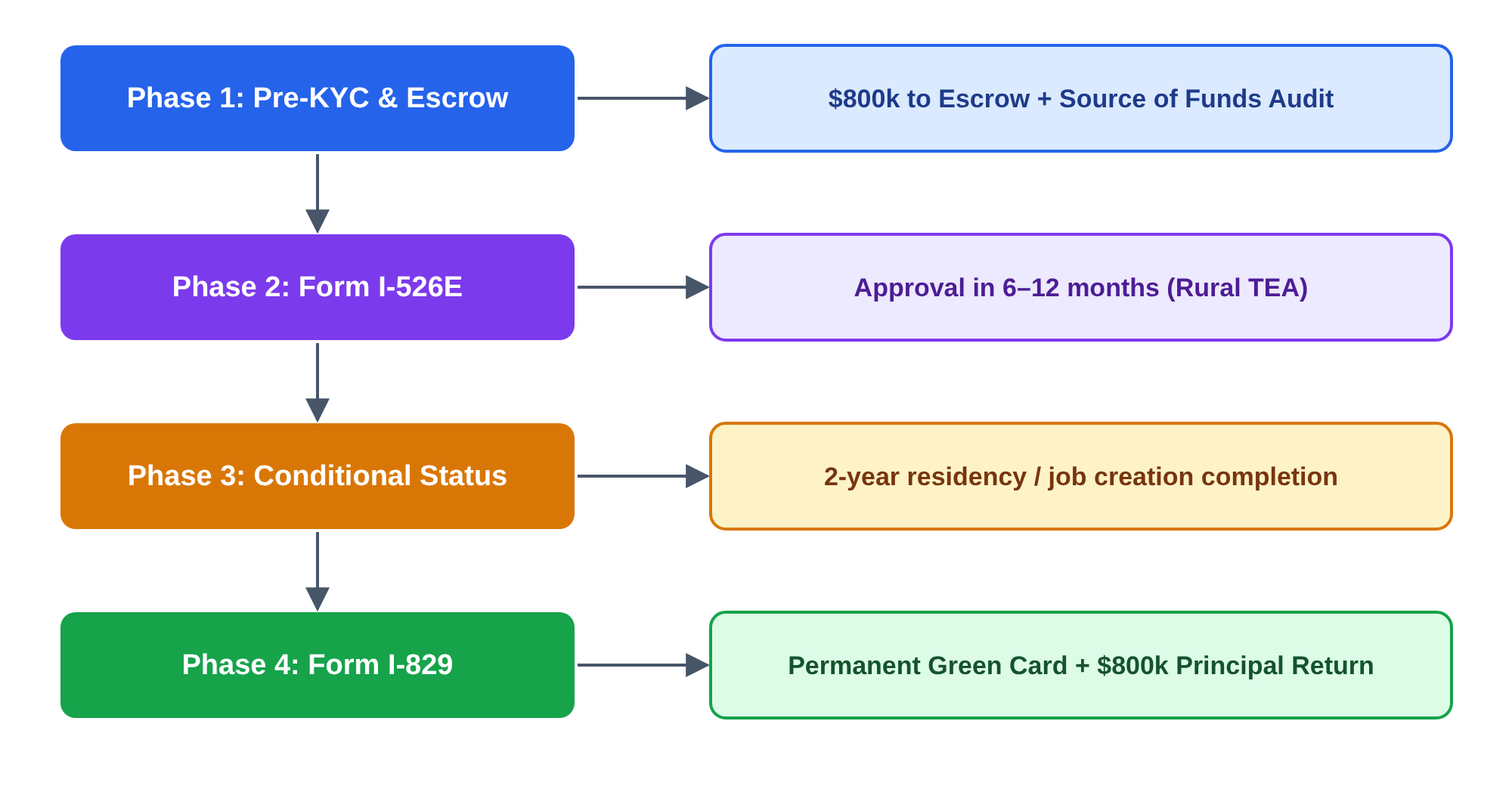
- Source of Funds (SoF) Audit & Pre-KYC Onboarding (1–2 months): Documenting the lawful origin of the $800,000 investment plus administrative fees ($70,000–$80,000). Acceptable sources include corporate dividend distributions, real estate sales proceeds, equity exits, asset-backed loans, or gifts. Capital is wired to the project’s escrow account.
- I-526E Petition Filing with USCIS (1 month): Immigration counsel submits Form I-526E. Adjudication for Rural TEA projects takes approximately 6 to 12 months.
- Conditional Green Card Issuance (3–6 months): Upon I-526E approval, the investor completes consular processing abroad or files Form I-485 for Adjustment of Status if physically in the U.S., receiving a 2-year Conditional Green Card.
- Condition Removal (I-829) & Capital Return (End of Year 2 of Conditional Residency): Within the 90-day window prior to conditional residency expiration, Form I-829 is filed, proving the creation and maintenance of 10 required jobs. Approval grants unconditional permanent U.S. residency to the investor and their family. Upon maturity of the underlying loan term (4–5 years), the Regional Center repays the $800,000 principal.
Selecting projects backed by substantial developer equity, institutional bank debt, and significant job creation cushions ensures the protection of capital alongside seamless immigration outcomes.
This material is for general information only and does not constitute legal, immigration, investment, or tax advice. Program requirements and processing practices may change. Individual results depend on the applicant’s circumstances, visa availability, USCIS decisions, and project performance.