
Legal Capital Protection and Institutional Framework
The U.S. safeguards investor assets through statutory mechanisms that strictly separate asset ownership from custody. The depository system isolates client assets from the balance sheets of brokerage firms.
Brokerage and fund operations are governed by three primary statutes:
- Securities Act of 1933: Regulates the initial registration of securities and public financial disclosures.
- Securities Exchange Act of 1934: Governs secondary markets, stock exchanges (NYSE, NASDAQ), and intermediary operations.
- Investment Company Act of 1940: Establishes operational standards for mutual funds and exchange-traded funds (ETFs).
The Securities Investor Protection Corporation (SIPC) automatically insures brokerage accounts up to $500,000 (including a $250,000 limit for cash balances) in the event of a broker-dealer bankruptcy. Tier-1 U.S. brokerages (such as Interactive Brokers, Charles Schwab, and Fidelity) secure supplemental private insurance through Lloyd’s of London syndicates, extending coverage limits to between $30 million and $150 million per client account.
The U.S. legal system blocks arbitrary asset expropriation through an independent federal judiciary. Relationships between investors and asset managers are governed by strict Fiduciary Duty standards. Asset managers bear personal criminal and financial liability for actions taken under unmitigated conflicts of interest.
Yield Structure: Equities, Fixed Income, and Commercial Real Estate
Returns across U.S. asset classes are backed by a century of verified market data. The S&P 500 index demonstrates a compound annual growth rate (CAGR) of 10.2% (1928–2025), assuming dividend reinvestment.
Comparative Parameters of Core U.S. Asset Classes
|
Asset Class |
Historical Yield (CAGR) |
Standard Deviation (Risk) |
Current Yield Level |
Non-Resident Tax Regime |
|---|---|---|---|---|
|
Equities (S&P 500) |
9.8% – 10.2% |
15.4% |
1.3% – 1.6% (Dividends) |
30% Dividends / 0% Capital Gains |
|
U.S. Treasuries (10Y) |
4.5% – 5.0% |
7.2% |
4.1% – 4.4% (Coupon) |
0% (Portfolio Interest Exemption) |
|
Corporate Bonds (IG) |
5.8% – 6.3% |
8.5% |
5.2% – 5.6% (Coupon) |
0% (Portfolio Interest Exemption) |
|
Commercial Real Estate (REITs) |
8.5% – 9.2% |
18.1% |
3.8% – 4.5% (Dividends) |
30% Withholding on Operating Income Distributions |
The U.S. Treasury market serves as the global risk-free rate benchmark. U.S. Treasury bonds guarantee principal and interest payments backed by the full faith and credit of the U.S. government. Investors receive a predictable coupon yield protected from issuer default risk.
Within Investment Grade corporate debt (BBB- rating and above by S&P), yield spreads trade 120 to 180 basis points above Treasuries. The historical default rate for this tier remains below 0.08% annually.
Commercial real estate structures operating as Real Estate Investment Trusts (REITs) are legally required to distribute at least 90% of taxable income to shareholders as dividends. This structure ensures transparent cash flows indexed to inflation via long-term Triple Net Lease (NNN) contracts.
Tax Regimes for Foreign and Institutional Investors
The U.S. Internal Revenue Code strictly differentiates between Capital Gains and current interest or dividend income for Non-Resident Aliens (NRAs) and foreign entities.
Tax Rates and Exemptions for Foreign Investors:
- Capital Gains Tax: Non-resident investors are fully exempt from U.S. capital gains taxes (0% rate) on the sale of publicly traded stocks and bonds, provided the investor does not hold U.S. tax residency status and spends fewer than 183 days in the U.S. during the tax year.
- Interest Income (Portfolio Interest Exemption): Coupon payments derived from U.S. Treasuries and corporate bonds are completely exempt from U.S. withholding tax at the source (0% rate).
- Dividend Withholding Tax: The statutory withholding rate on dividends paid by U.S. corporations to non-residents is 30%. Applicable Double Taxation Treaties (DTT) reduce this rate to 5%–15% depending on the investor’s tax residency.
- Real Estate Tax Obligations (FIRPTA): The sale of direct real estate or shares in entities holding 50% or more of their gross assets in U.S. real property is governed by the Foreign Investment in Real Property Tax Act. Buyers must withhold 15% of the gross purchase price toward potential capital gains liability.
Utilizing personal holding entities (such as LLCs or C-Corporations) and offshore trust arrangements enables legal optimization against the U.S. Estate Tax, which imposes an exemption threshold of just $60,000 for non-residents and top marginal tax rates reaching 40%.
Market Entry Protocol and Compliance Framework
Opening an institutional account and deploying capital into U.S. markets requires compliance with standardized Know Your Customer (KYC) and Anti-Money Laundering (AML) protocols.
Institutional Market Onboarding Workflow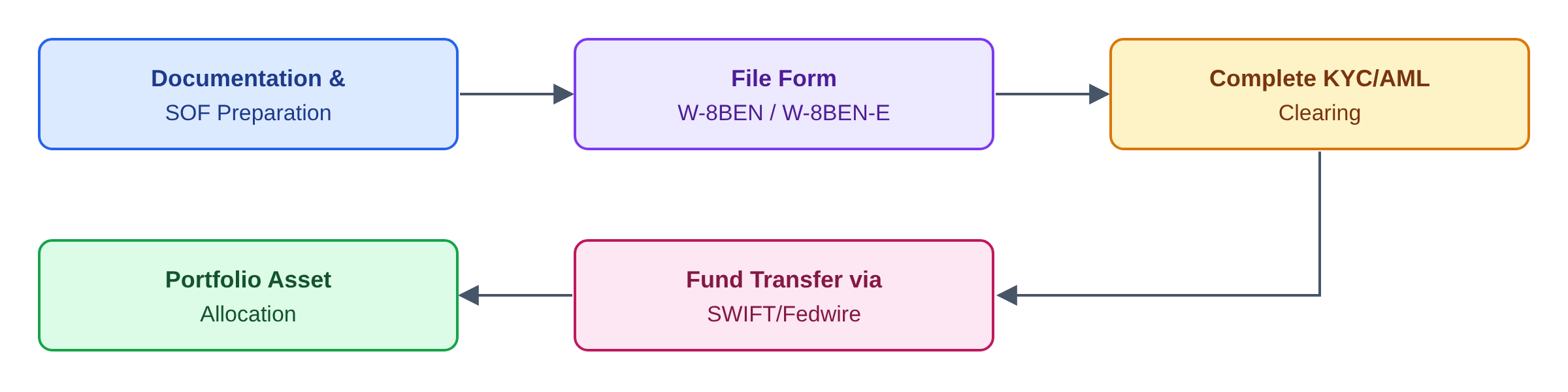
The execution protocol comprises five sequential steps:
- Source of Funds Tracing: Verification of legal capital origin through tax returns, property transaction deeds,dividend distribution records, or multi-year corporate audit filings.
- Custodial Selection: Opening a direct brokerage account under U.S. jurisdiction, setting up an omnibus sub-account via European intermediaries, or utilizing offshore fund structures (Cayman/Malta).
- Tax Documentation Filing: Individual investors submit Form W-8BEN; legal entities file Form W-8BEN-E. These filings certify foreign status and activate treaty-reduced withholding tax rates.
- Capital Transfer (Fedwire / SWIFT): Wire transfer of funds directly from the investor's banking institution into a segregated client account held by the broker or custodian bank.
- Asset Allocation: Execution of capital deployment into targeted securities in alignment with liquidity mandates and currency diversification strategies.
Enforceable legal protections, SIPC insurance coverage, unmatched asset liquidity, and a 0% capital gains tax rate for foreign investors maintain the U.S. market's position as the primary destination for international capital preservation and growth.
This material is for general information only and does not constitute legal, immigration, investment, or tax advice. Program requirements and processing practices may change. Individual results depend on the applicant’s circumstances, visa availability, USCIS decisions, and project performance.